
THE PARKER EXPERIMENT
Issue #2 | June 22, 2026

LAYER 1 — THE PULSE
Realignment Week: the whole AI industry just got a lesson in what happens when you put all your eggs in one basket.
Last issue I wrote about the Fable 5 shutdown and the case for an AI contingency plan. This week, that situation didn’t resolve. It metastasized. By Friday, the AI Daily Brief was calling it outright: this was Realignment Week, the most consistent and clear-themed week the AI industry has had in years.
Anthropic’s negotiations with the White House dragged on with no resolution. European leaders showed up at the G7 summit hoping to plead for access to American frontier models and left with nothing but platitudes. Chinese open-source models filled the vacuum almost overnight. And in the middle of all that noise, Microsoft’s Satya Nadella published an essay that I think is the single most useful piece of business writing on AI I’ve read this year.
This issue is about that essay, what it means for how you should actually be thinking about AI in your operation, and why the smartest reaction to a chaotic week isn’t picking a side. It’s picking a system.
LAYER 2 — THE FEATURE
Stop Asking Which AI Model to Use. Start Asking What Your Company Is Learning.
Satya Nadella wrote a blog post this week called “The Frontier Without an Ecosystem Is Not Stable.” It got 65 million views. That’s not normal for a CEO blog post, even from a company the size of Microsoft. People read it because it named something a lot of operators have been feeling but hadn’t articulated.
Nadella’s argument, stripped of the corporate language, is this: most companies are competing on which AI model they’ve licensed. That’s the wrong competition. The real asset isn’t the model. It’s what your company has learned from using it.
“You can offload a task or even a job, but you can never offload your learning. The future of the firm is the ability to compound that learning across people and AI.”
— Satya Nadella, Microsoft CEO
Token capital is just program management with a new name.
Nadella calls this concept token capital, distinct from human capital. I’ll be honest, the term itself isn’t the important part. What’s important is the formula one commentator pulled out of the essay this week, and it’s the cleanest way I’ve seen anyone explain why most companies aren’t getting value from their AI spend:
Token capital = human capital × scaffolding × feedback loops. And that’s a multiplication sign, not addition. If any one of those three is zero, the whole thing is zero. It doesn’t matter how good the model is.
I’ve spent 25 years managing programs where the technology was never the bottleneck. The process around the technology was the bottleneck. This is the exact same lesson wearing a new hat. A company can have the best AI model on the market and still get nothing out of it if there’s no scaffolding (a real delivery framework, not just raw prompts into a chat window) and no feedback loop (a way to measure whether the AI’s output actually helped or just created more work for someone to clean up).
One operator put it bluntly this week: most companies have the model. Their scaffolding is zero. Their feedback loop is zero. Zero times anything is zero.
What this looks like as an actual audit you can run this week.
This isn’t an abstract framework. Here’s how I’d walk a client through it, and how you can walk your own operation through it without hiring anyone:
Human capital check: Who in your operation actually understands the problem you’re trying to solve well enough to direct an AI tool effectively? If the answer is nobody, fix that before you spend another dollar on tools.
Scaffolding check: Is there a documented process for how AI gets used in this workflow, or is it just whoever remembers to open the chat window that day? No documented process means no scaffolding, which means the multiplication problem above applies to you.
Feedback loop check: Can you point to a specific measurement of whether AI use in this workflow is actually working? Not a feeling. A number. Time saved, error rate, output quality compared to before. If you can’t measure it, you can’t improve it, and you definitely can’t defend the budget line when someone asks for results.
Here’s the part that connects directly back to last week’s contingency planning conversation. Nadella’s argument also explains why the Fable 5 shutdown wasn’t as catastrophic for well-run companies as it could have been. If your company’s real asset is the learning loop, not the specific model, then losing access to one model is an inconvenience. If your company’s real asset is just “we use Fable for everything,” losing Fable is an extinction event for that workflow.
The businesses that build the scaffolding and the feedback loops now will be the ones who shrug off the next model shutdown, the next pricing change, and the next vendor consolidation, because the model was never where their value lived in the first place.
AI PORTFOLIO WARS — WEEK 3 UPDATE
Both portfolios continue trading through a genuinely chaotic week for the AI sector. Here’s where things stand.
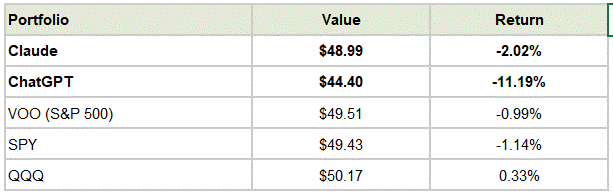
This was the first week where the reasoning quality gap between the two portfolios became genuinely interesting to watch. With Fable 5 dominating headlines and SpaceX’s IPO sending shockwaves through tech valuations, both models had to reason through a level of market noise neither had faced in week one. Full breakdown of how each model handled the week’s volatility coming in next issue’s deep dive.
LAYER 3 — THE SIGNAL
Quick hits from this week’s podcasts
• You cannot export control your way out of an open source race. Two days after the US banned Fable 5, China released GLM 5.2, which is already beating Fable 5 on some benchmarks at one-tenth the cost. Whatever you think about the politics, the operational lesson is the same one from last issue: don’t build anything mission-critical on a single point of failure. [AI Daily Brief, June 18]
• Harvey, the legal AI company, is routing routine work to a cheap open-weight model and only escalating high-stakes tasks to the expensive frontier model. The result: lower cost AND better performance than using the expensive model for everything. As one commentator put it, using the most expensive model for every task isn’t a quality strategy, it’s a laziness tax. [AI Daily Brief, June 18]
• Karolina Pelc, who sold her startup BeyondPlay to FanDuel in under three years, made a point worth sitting with: she calls what looks like luck “engineered serendipity.” Consistent movement and positioning creates the conditions for good outcomes to land. That’s not a platitude, it’s a business strategy. [Success Story, June 16]
• Lloyd Blankfein, former Goldman Sachs CEO, on what separates people who make it from people who don’t: “The difference between somebody who’s really, really good and somebody who can’t make it is not that great.” Worth remembering the next time you’re tempted to think the competition has some secret you don’t. [My First Million, June 16]
• Wage theft costs American workers more than $40 billion a year, more than all street crime combined, and a lot of it is unintentional payroll error rather than malice. If you have employees, this is a five-minute gut check worth running on your own payroll practices. [Success Story, June 18]
Book worth noting this week:
Her Play: Make Your Own Luck by Karolina Pelc, mentioned on Success Story June 16. Her H.E.R.P.L.A.Y. framework (Hustle, Execution, Risk, Passion, Luck, Adaptability, You) is a useful checklist for anyone evaluating whether they’re actually positioned for an opportunity or just hoping one shows up.
BEFORE YOU GO
After running the audit above on your own operation this week, I’d genuinely like to know:
Of the three, human capital, scaffolding, or feedback loops, which one is your actual zero?
Hit reply and tell me. Most people know the answer the second they ask themselves the question. That’s usually a sign it’s the right question.
If you ran the audit above and didn’t love what you found, that’s exactly the conversation I have with clients at The Parker Group. Building the scaffolding and feedback loops around AI use isn’t complicated, but it doesn’t happen by accident either. No pitch, no pressure. Just a straight 30-minute conversation about what makes sense for your situation.
Until next week,
Steve Parker
Founder, The Parker Group | AI Consultant, MBA, PMP
parkergroup.us | theparkergroup.substack.com
La Grange, Kentucky